It's October. The leadership team is discussing next year's growth targets, department heads are asking for additional resources, and someone in finance wants to know how many employees the company plans to hire in 2027.
The answers start coming in.
Sales needs six people. Engineering wants eight. Customer Success needs another four. Marketing has been asking for two positions since July.
Before anyone realises it, there's a list of twenty vacancies.
But here's the question that often gets missed: Does the business actually need twenty new employees, and can it realistically hire them within the planned budget and timeline?
A good hiring plan isn't simply a list of job openings. It connects business objectives, workforce requirements, compensation budgets and recruitment capacity.
Whether you're a startup planning your next funding round or an established company expanding into new markets, here's how to build a hiring plan for 2027 that your business can actually execute.
What Does India's Hiring Outlook Tell Us About 2027?
India is entering the new year with relatively positive hiring sentiment.
According to ManpowerGroup's Employment Outlook Survey for Q4 2026, 65% of the 3,055 Indian employers surveyed planned to increase staffing during October to December 2026.
TeamLease's Employment Outlook Report for the second half of FY2026–27 also projected a 5.4% net employment change between October 2026 and March 2027. Its findings highlighted stronger hiring intentions in sectors including e-commerce, technology startups, travel and hospitality, and retail.
These reports cover different periods and use different measures. Neither should be treated as a prediction of your company's 2027 hiring requirements.
But they do highlight an important consideration: businesses planning to expand will need to think carefully about the skills they require and how efficiently they can recruit them.
A July 2026 study by upGrad Rekrut, covering more than 11,000 HR, talent and business leaders, reported that nearly eight in ten participating organisations had hired below their planned targets.
That's worth paying attention to.
The problem isn't always that companies don't want to hire.
Sometimes the hiring plan itself is disconnected from what the organisation can realistically deliver.
Step 1: Start With Business Goals, Not Job Titles
Imagine a SaaS business expects to double its enterprise customer base in 2027.
The immediate response might be to recruit more software developers.
But what happens when those customers begin onboarding?
The company may also require implementation specialists, customer success managers, support engineers and additional sales capacity.
Adding engineers alone won't necessarily solve the problem.
Before planning headcount, ask each department head three questions:
- What business outcome are you responsible for delivering in 2027?
- What additional capabilities do you need to achieve it?
- Can those capabilities be developed internally, automated, outsourced or shared before creating a new position?
This helps separate genuinely necessary hiring from requests that may be solved differently.
For instance, a department asking for three additional analysts may actually need better reporting automation and one experienced data professional.
Another department asking for one senior manager may need two operational specialists instead.
Start with the work that needs to get done. Then decide who needs to do it.
Step 2: Calculate Your Actual Headcount Requirements
This is where many annual hiring plans begin to fall apart.
Companies often consider only additional positions required for growth. They forget to account for employees likely to leave.
Let's take an example.
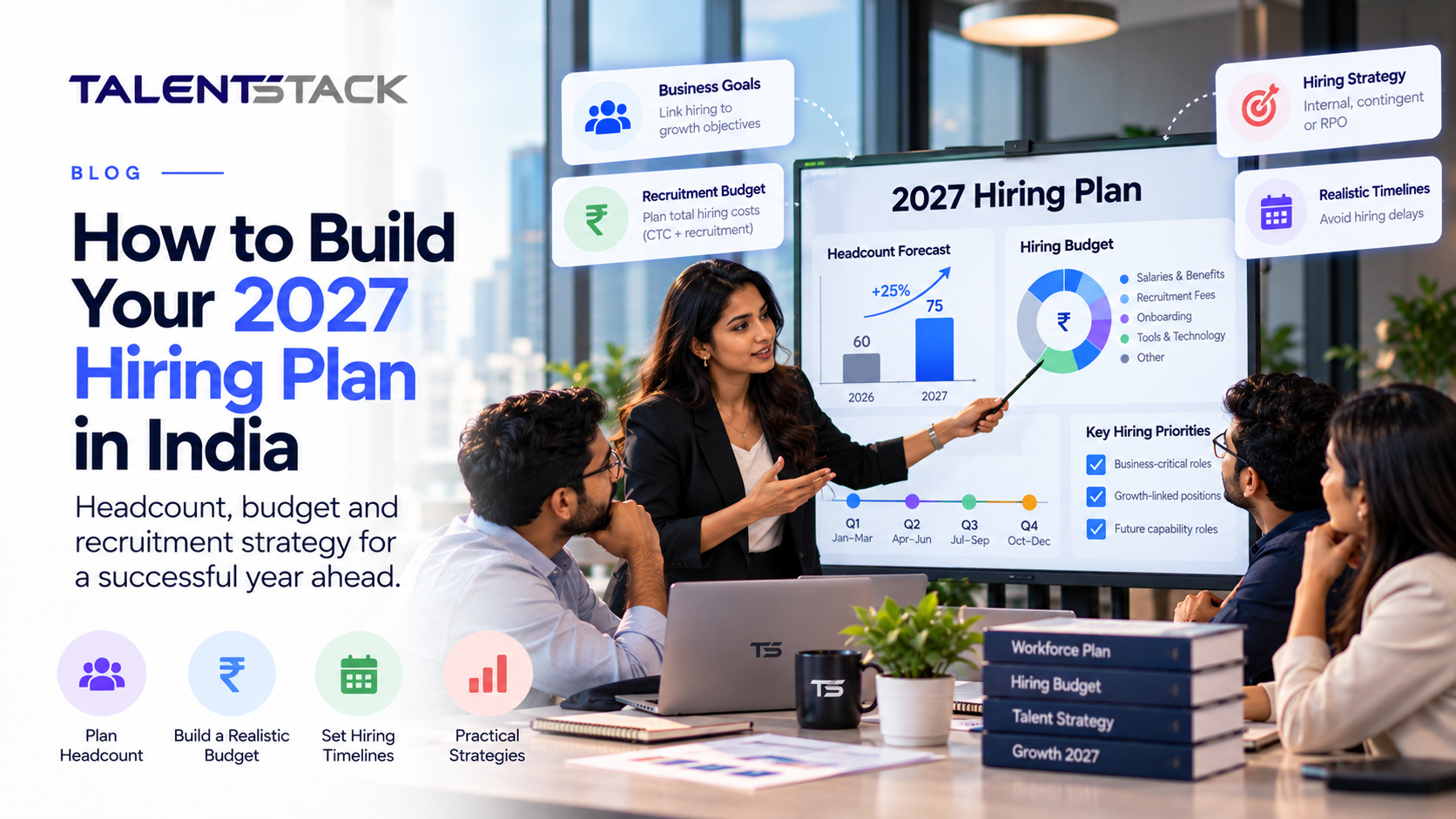
A growing company begins 2027 with 60 employees.
By December, it wants to have 75 employees.
Based on its historical attrition and current workforce information, it estimates that six employees may leave during the year.
The calculation is straightforward.
Required hires = Target year-end headcount − Opening headcount + Expected employee exits
Using our example:
75 − 60 + 6 = 21 hires.
The company needs to complete 21 hires, not 15, to reach its target workforce size, assuming the expected exits occur and all other workforce changes are accounted for.
Of those 21 hires:
- 15 support net workforce growth.
- 6 replace employees expected to leave.
This distinction matters because replacement hiring and expansion hiring have different business implications.
Replacement positions may need to be filled quickly to maintain operations.
Growth positions may depend on revenue targets, funding, project approvals or customer demand.
Your hiring plan should identify both separately.
Step 3: Decide Which Roles Are Business-Critical
Not every vacancy deserves the same level of urgency.
A startup might need a senior backend engineer immediately because product delivery depends on that person's expertise.
The same business might want to hire a second marketing designer, but that vacancy may be less urgent if external support is already available.
That doesn't make one function more important than another.
It means hiring priorities should reflect the company's current business constraints.
We recommend grouping planned positions into three categories.
Priority 1: Business-Critical Positions
These roles directly affect revenue, product delivery, operational continuity, regulatory obligations or other essential business outcomes.
Delays in filling them create meaningful business risks.
Examples might include a Head of Engineering, an enterprise sales leader or a specialist responsible for maintaining a critical system.
Priority 2: Growth-Linked Positions
These roles become necessary when the company reaches a particular milestone.
Perhaps the business plans to hire more customer success professionals after signing a certain number of enterprise customers.
Or it needs additional manufacturing supervisors when a new production line becomes operational.
The recruitment process can begin before the milestone, but final hiring approval should be connected to actual business demand.
Priority 3: Future-Capability Positions
These positions strengthen the organisation's longer-term capabilities.
They might include a dedicated AI specialist, employer branding professional or strategy analyst.
They're worth planning for, but they should be reviewed against immediate business priorities and financial capacity.
When budgets become tighter, this classification makes it easier to adjust the hiring plan without making arbitrary cuts.
Step 4: Build a Realistic Recruitment and Employee Cost Budget
A hiring budget should include more than the annual CTC printed on an offer letter.
Employers need to think about two separate costs:
The cost of employing people and the cost of recruiting them.
A. Employee Compensation and Onboarding Costs
Start with the salary or CTC budget for every proposed position.
Include applicable employer contributions, benefits, bonuses and other employment costs that are not already captured in your chosen CTC definition. Avoid counting the same item twice.
You may also need to budget for equipment, software licences, onboarding, training and workspace expenses.
Let's return to our example.
The company expects to hire 21 employees during 2027.
Assume an average annual CTC of ₹12 lakh per new employee.
The annualised CTC associated with those 21 positions would be:
21 × ₹12,00,000 = ₹2.52 crore
However, that doesn't mean the company will pay ₹2.52 crore to those new joiners during 2027.
If each employee joins around the middle of the year and is employed for six months on average, the approximate CTC attributable to their time employed during 2027 would be:
₹2.52 crore × 6/12 = ₹1.26 crore
This is a simplified illustration. Actual costs depend on joining dates, compensation structures and other factors.
Also, six of these positions are replacements. Their cost must be considered alongside the compensation that would otherwise have been paid to departing employees.
To forecast the company's total payroll accurately, calculate employee costs month by month across both existing and new staff.
B. Recruitment Costs
Next, budget how much it will cost to find and hire the employees.
These expenses may include internal recruiter salaries, recruitment agency fees, job boards, sourcing platforms, background checks and other directly attributable hiring expenses.
For example, suppose ten of the company's planned hires are handled through a recruitment agency.
If the average CTC is ₹12 lakh and the agreed placement fee is 10%, each successful hire would attract a fee of ₹1.2 lakh.
For ten hires:
10 × ₹1,20,000 = ₹12 lakh in agency fees.
That is only one part of the recruitment budget. The remaining hires may be managed internally or through another engagement model.
These are hypothetical figures, not a market-wide pricing benchmark or a TalentStack quotation.
For companies hiring consistently, it is worth comparing traditional recruitment fees against a dedicated recruiter or RPO arrangement.
The right comparison depends on how many hires you realistically expect to complete, the types of roles involved and the capacity required.
Step 5: Calculate How Much Recruitment Capacity You Need
You have a target of 21 hires.
But do you have enough recruitment capacity to achieve it?
This is a question businesses often overlook.
An internal HR executive may already be handling payroll coordination, onboarding, employee engagement and operational responsibilities.
Adding twenty recruitment requirements to that person's workload doesn't automatically create the capacity to close them.
Start by examining your historical hiring data.
How many candidates did you screen to make a successful hire?
How many interviews were required?
How many offers were issued?
And how many candidates actually joined?
Work Backwards From Your Hiring Target
Here's an illustrative calculation.
Suppose your business needs 21 employees to join.
Based on your own past results, you assume:
- 80% of issued offers will be accepted.
- 85% of accepted offers will result in joining.
The number of offers you should plan for is approximately:
21 ÷ (0.80 × 0.85) = 31 offers
That means your recruitment team may need to issue approximately 31 offers to achieve 21 joins under those assumptions.
These percentages are examples, not established industry benchmarks. Replace them with your company's historical data wherever possible.
You can then work further backwards using interview-to-offer and screening-to-interview conversion rates.
This helps you estimate workload and decide whether additional recruiting resources are necessary.
Recruiter capacity is not a universal number. A professional handling five complex leadership searches may have a heavier workload than someone managing more standardised, high-volume roles.
Step 6: Spread Your Hiring Plan Across the Year
A yearly hiring target is useful for budgeting.
It's not enough for day-to-day execution.
If a business needs 21 people in 2027, it should decide when those employees are actually required.
Here's one possible distribution:
| QuarterPlanned hires | |
| January–March | 7 |
| April–June | 6 |
| July–September | 5 |
| October–December | 3 |
| Total | 21 |
This is a planning example, not a recommended hiring distribution for every company.
A business preparing for a product launch may need to hire aggressively during the first quarter.
Another business may wait until funding is secured or customer demand increases.
Once the schedule is defined, work backwards.
If a critical employee needs to join in April, when must sourcing begin?
How long does the interview process usually take?
What is the likely notice period?
How much time is required for internal approvals?
Recruitment timelines should be based on evidence from previous searches and current market conditions, rather than assuming every vacancy can be filled within thirty days.
Step 7: Decide What to Recruit Internally and What to Outsource
There is no reason every organisation must handle recruitment in exactly the same way.
A growing company might use different approaches for different requirements.
Internal Recruitment
An internal talent acquisition team may be the right choice when hiring volume is stable, the company has established sourcing channels and recruiters have enough capacity.
The advantage is close integration with the organisation's culture, hiring managers and processes.
Contingent Recruitment
External recruitment agencies can support specific vacancies, particularly when companies need access to specialist sourcing capabilities or additional bandwidth.
Under a typical contingent arrangement, the employer pays an agreed fee after the applicable hiring milestone is achieved.
This can work well when hiring needs are occasional or vary significantly across functions.
Dedicated Recruiter or RPO
For sustained hiring, an embedded recruitment partner may be more suitable.
This provides agreed recruiting capacity over a defined period rather than treating every position as a completely separate assignment.
Depending on the engagement, the recruiter may support sourcing, screening, interview coordination, reporting and offer management.
Executive Search
Senior leadership and confidential positions may need a different search approach.
A CEO, CTO, CFO or business-unit leader should not automatically be recruited through the same process used for routine vacancies.
These searches often require targeted market mapping, confidential outreach and a deeper evaluation of leadership experience.
The right model depends on the work involved.
A sensible recruitment plan can combine internal hiring, contingent recruitment, dedicated support and executive search.
Step 8: Build Three Hiring Scenarios
One of the easiest ways to create a fragile hiring plan is to assume the business will grow exactly as expected.
Revenue may be delayed.
A funding round may take longer.
A new customer may generate more demand than anticipated.
Instead of creating only one hiring forecast, prepare three.
Conservative scenario: Hiring is limited to essential replacements and the most important business-critical positions.
Base scenario: The company proceeds with its approved growth plan and fills roles according to expected business demand.
Expansion scenario: The company grows faster than planned and needs additional recruitment capacity.
Using our earlier example, the business could model 12 hires in a conservative scenario, 21 in its base scenario and 30 in an expansion scenario.
These are illustrative targets.
For each scenario, estimate compensation costs, recruitment costs, the likely hiring timeline and the delivery resources required.
Then define the conditions that would trigger a change.
Perhaps additional sales hiring begins only when recurring revenue reaches an agreed level.
Perhaps engineering hiring accelerates after product funding is approved.
The purpose is to make hiring responsive to business performance without losing control of costs.
Step 9: Review Your Hiring Plan Every Month
An annual plan shouldn't sit untouched in a spreadsheet until the next budget cycle.
It needs regular attention.
We recommend a monthly hiring review involving the relevant business leaders, HR and finance.
A useful review should answer:
- How many employees were expected to join this month?
- How many actually joined?
- Which vacancies are delayed, and why?
- Are we within the approved compensation and recruitment budgets?
- Are hiring managers providing timely feedback?
- Do we have enough recruitment capacity for the next 60–90 days?
It is also worth separating hiring activity from hiring outcomes.
A recruiter may source hundreds of candidates and arrange dozens of interviews.
Those activities can be useful indicators, but they don't necessarily mean the business is making progress towards its workforce target.
A better dashboard tracks qualified candidates, interview conversions, offers, joining rates, recruitment costs and vacancies that are creating business risks.
The goal is to identify problems early enough to do something about them.
A Simple 2027 Hiring Plan Template
Before finalising your annual budget, make sure your workforce planning sheet includes the following information for every role.
Position and department: What role is required, and which team owns it?
Hiring purpose: Is this a replacement, growth position or new capability?
Business priority: Is it critical, growth-linked or longer-term?
Target joining date: When must the employee begin work?
Compensation budget: What is the approved fixed, variable and total employment cost?
Recruitment approach: Will the role be handled internally, through contingent recruitment, RPO or executive search?
Hiring owner: Who is responsible for the final decision, and who manages the process?
Current status: Is the role planned, approved, open, offered or filled?
Dependencies: Does hiring require a customer contract, funding approval, new office or another business milestone?
With these fields, leadership can see what the company intends to hire, when it needs those people and what the commitments may cost.
More importantly, the plan becomes something recruiters can execute.
How TalentStack Can Support Your 2027 Hiring Plan
At TalentStack, we believe recruitment should begin with understanding the business, not simply collecting job descriptions.
A company hiring two specialist engineers requires a different approach from a startup planning to build a 30-person team.
That is why we work across different recruitment models, including contingent recruitment, dedicated recruiter engagements, RPO and executive search.
For businesses planning recurring hires, we also provide an RPO Savings Calculator to help compare fixed monthly recruitment support against traditional per-hire recruitment fees.
The comparison is illustrative, but it can provide a useful starting point for budget discussions.
A good hiring plan should do more than identify vacancies.
It should help your business determine what skills it requires, how quickly it needs them, how much the recruitment process may cost and which delivery model makes sense.
Frequently Asked Questions About Hiring Plans
When should companies start planning recruitment for 2027?
Ideally, before the beginning of the financial or calendar year being planned. October and November 2026 provide an opportunity to align the 2027 business plan, headcount requirements, compensation budgets and recruitment resources.
How do you calculate the number of employees to hire?
Start with your target headcount, subtract your current headcount and add expected departures. Adjust for other planned workforce changes. Separately identify replacement hires and growth positions so the business understands why each vacancy is required.
How much should a startup budget for recruitment?
Recruitment spending depends on hiring volume, compensation levels, internal recruiter costs, sourcing tools, agency fees and the engagement model. Companies should calculate their expected recruitment costs using their own hiring plan rather than applying one fixed percentage across every role.
How many recruiters does a company need?
There is no universal recruiter-to-hire ratio. It depends on job complexity, sourcing requirements, candidate availability, interview conversion rates and the responsibilities assigned to each recruiter. Historical hiring data is the best starting point for estimating capacity.
Should businesses outsource recruitment in 2027?
Outsourcing can make sense when the internal team lacks capacity, hiring needs are specialised or the business requires sustained recruitment support without immediately building a larger permanent TA function. The commercial decision should be based on workload, role complexity and realistic hiring volumes.
Final Thoughts
Every business wants to start the new year with ambitious goals.
New customers. New markets. Better products. Faster growth.
But those goals become difficult to achieve when the people required to deliver them are not in place.
A hiring plan gives your business a clearer view of the talent, budgets, timelines and recruitment resources it needs.
It also creates room to make better decisions when circumstances change.
Because the objective isn't to hire as many people as possible.
It's to have the right people, with the right capabilities, in place when the business needs them.
Planning Your 2027 Hiring Budget?
Whether you're planning five hires or fifty, TalentStack can help you evaluate your requirements, recruitment model and hiring capacity.
If you'd like to compare the economics of contingent recruitment and dedicated recruiter support, start with our RPO Savings Calculator.
Or speak with TalentStack to discuss your 2027 workforce plan.